

Japan: lost in introspection

There has been a lot of speculation about what will happen to the Japanese electronics companies, and in particular their semiconductor divisions, all of which are bleeding money.

If you visit Japan you get some idea of the problem. Everything is too inward looking. All the mobile phones are great and seem in some ways to be ahead of what we have in the US, and they are all made by Japanese manufacturers. But that is the problem, they are made by manufacturers who have given up in the rest of the world.

Greg Hinckley, the COO of Mentor Graphics, once told me about interviewing a candidate for a finance position who came from American Airlines. Their focus, the candidate said, was to touch down 30 seconds ahead of United. It was as if Southwest and Jet Blue and all the rest didn’t even exist. Being the best airline just meant being the best legacy airline: beat United, Delta and the others.

The Japanese cell-phone companies are like that. They are so competitive for their share of the Japanese market that they have given up on the global market and what it takes to compete there. Of course, the Japanese cell-phone transmission standards are different which means that you have to decide whether to compete in Japan, overseas or both. Those different standards may have looked like a giving a good unfair advantage to the Japanese since Nokia, Ericsson or Samsung were unlikely to focus on the Japanese standard first even during the initial high-growth period. Even today, Nokia, the world’s biggest cell-phone manufacturer has less than 1% market share in Japan. But on the other hand the Japanese manufacturers have no market share in the rest of the world, which is orders of magnitude bigger. Sony is an exception (Sony is almost always an exception) but perhaps only because it has a joint venture with Ericsson rather than going it alone.

Motorola had the same problem in the digital transition away from analog phones, where it was the biggest manufacturer in the world. The rest of the world went digital with GSM (which back then stood for Groupe Spécial Mobile before it got renamed as Global System for Mobile communications). The US initially decided to simply make the voice channels of their analog system AMPS into digital channels to form D-AMPS, which was what AT&T wanted. So Motorola had to focus on making handsets and base stations for that American-only standard (I think it was used in Israel too) and largely missed the transition in the rest of the world by focusing inward. Much later, AT&T gave up on IS-136 that D-AMPS had morphed into and switched to GSM (although the current AT&T uses GSM mainly because SBC and PacBell Wireles went with GSM from the start and ended up acquiring the old AT&T). When you look where it came from, it is amazing that Motorola’s wireless division looks unlikely to survive.

I was in Japan most recently last summer when I was CEO of Envis. On a completely off-topic note I finally did something I’ve wanted to do for a long time: I got up at 5 in the morning and visited the Tsukiji fish-market. I recommend making the effort, and with jet-lag you’ll probably be awake at 5 in the morning in any case. Nothing like unagi (eel) and green-tea for an early breakfast.

Visiting Japan really is captured well in the movie “Lost in Translation.” Being awake in the middle of the night with jetlag, the weird stuff on TV, the atmosphere of the bars in the international hotels, Shinjuku in the rush-hour. Unfortunately I’ve never had the Scarlett Johansen lying on my bed bit.

Visiting the usual semiconductor companies I got the feeling that they were all only competing with each other. By and large they were making chips to go into consumer electronics products for the Japanese market. There were obviously far more products and far more chips being done than could possibly make money, just like all those cell-phones and cell-phone chips couldn’t be making money (not to mention that the Japanese market is already saturated).

With too many companies, and too many uncompetitive semiconductor divisions, consolidation is to be expected. But Japanese politics is inward facing too and so they can only merge with each other and gradually move towards what I call Japan Inc in the semiconductor world (to be fair, this same issue is one that affects my American Airlines example; British Airways or Lufthansa is simply not allowed to buy a major stake, recapitalize them and clean them up because congress has laws preventing it). So it looks like gradually the semiconductor companies will consolidate into a memory company (Elpida) and a logic company and, based on past history, they won’t take the hard decisions necessary to be competitive globally rather than just in Japan.

Posted in semiconductor | Comments Off

Guest blog: Kathryn Kranen

Kathryn Kranen is the CEO of Jasper Design Automation. In Q4 last year, to the amazement of anyone watching, they closed a round of funding. More surprising still, they didn’t simply raise money from their existing investors, they brought on a new lead investor. Since, in the current economy, this is really unusual I asked her to give the rest of us the benefit of her advice on how to do it.
An outline for fund-raising success

Since Jasper raised its D-round of venture financing during Q4 of 2008, many people have asked me what it takes to close a round in today’s tough economic climate. Of course, the answer depends greatly upon your company’s stage of development, and ultimately, the market opportunity for your products. It may seem counterintuitive, but great ideas and technology with massive market potential are not always enough. The people funding your company will be most interested in market validation. Ask yourself honestly: do you have customers, references, a substantiated business model (including pricing), and good prospects for growth? If not, you may have a difficult time attracting venture capital in today’s environment. A better strategy might be to reduce your operating expenses and find alternate sources of cash to weather the next year or more.

After going through multiple funding rounds in both good and bad economies since the ‘90s, I have learned a number of lessons that can increase your chances for success.   Most importantly, develop a financing strategy before you start. Successful fund-raising begins with laying the groundwork long before you make your first pitch and with recognizing that timing is everything. 

To begin with, get a good coach. Although the active participation of your existing investors will be invaluable, and most of their coaching will be excellent, it is important to realize that your investors’ financial interests are not completely aligned with the interests of the company or its common shareholders (employees) in a new financing, due to the differing rights of preferred vs. common shareholders. Whether an existing investor or a neutral advisor, your coach must be someone who knows the ins and outs of financing and can share their insights on what is happening below the surface, such as:

  • what criteria VCs will really use to evaluate your prospects;
  • how to filter out the flattery and tell whether a VC is serious about investing;
  • what your existing investors must be thinking – not just your particular board members, but all the partners in their firms who must vote whether or not to re-invest!

A good coach will help you in advance to determine: Is now the right time to be seeking your next round of funding? Which of your company’s strengths will likely resonate with VCs? How many VCs should you be speaking to – just one, or several?

As for timing – if you are a startup looking to raise a Series B or later round, you may be less ready to go for your next financing than you think. How is your market validation? If a VC called your customers – and they will – what would they say? Conserving cash while you build up a solid customer base and reputation will greatly increase your chances of getting funded.

When you are ready to go for funding, it is time to develop a list of candidate VCs that fit your company’s profile, and to decide how many meetings you should schedule. The number of VCs you see will be different depending on the climate, funding stage, and your strategy. In our latest $7 million round, a board member introduced us to one VC early on as an ideal partner for our current needs, and that VC led the financing. In an earlier round, in a different economic climate, we met with a dozen or so VCs within a two-week period, creating energy and competition in the VC community. It was great experience, and allowed us to carefully choose the best fit for Jasper at an attractive valuation.

When you finally do pitch your company to target VCs, what do you think they will lock onto? Paradoxically, it is the bad news – they will listen to every word of your pitch but pay the closest attention to anything about your plan, your team, your business model, your competitive stance, your customers’ experiences, etc., that could possibly be flawed. The VCs are evaluating risk here, after all, while you are selling them on your merits. So be sure to have a counter for anything that could be perceived as a negative, or even plant some so they can be readily addressed when the time comes.

But of course you should highlight the good news too! Some advice I picked up from a coach is to lead with strength by putting your best argument for why they should fund you at the very beginning of the presentation, somewhere within the first three slides. Take us for example; in 2008 Jasper doubled its sales and tripled its market share. Why hide that fact until the summary? It became the very first slide in my pitch, before even introducing our product domain. Break the rules that say you need six slides to introduce your building, management team, and website before you impart anything relevant.

Once some VCs enter the “courtship” (due diligence) phase, leverage back-channel communications to create positive impressions. Hearing good things about your company from a trusted high-level source, such as the CEO of one of their portfolio companies, one of your customers, or a member of your board they know personally, will have more impact on a VC than hearing those same things from a company insider.

There is no doubt that raising money today is a challenge and may stay that way for quite some time. However, EDA companies with solid market validation can raise money. After all, EDA offers strong technology barriers and an established business model. VCs in general have a lower appetite for risk than in years past, and more reasonable expectations on returns. By creating a solid foundation for your business first, getting advice from those who know the game better than you, and carefully orchestrating your fund-raising process, you may just find yourself with a term sheet in your hands much sooner than expected! 

Posted in guest blog | Comments Off

Relevance lost

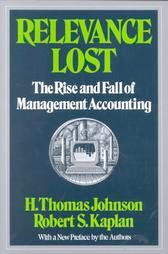
If you are at all interested in accounting I recommend the book Relevance Lost by Thomas Johnson and Robert Kaplan. I think it is a fascinating background to how we ended up with the kind of finance departments we have, but I admit it might be a minority interest. I had a girlfriend once who was in finance and I couldn’t even interest her in reading my copy.

Although published in 1991 it is still in print. It covers how accounting used to be useful to managers, starting with New England mill owners in the 19th century. However, as the accounting rules and processes were hijacked by financial accounting they have become steadily more and more useless for managing the business. Nobody wants to keep multiple sets of books so managers try and manage using accounts put together for financial accounting reasons on a timescale driven by financial accounting deadlines.

The situation is even more disconnected in the case of a software or design company. Much of the real value of the company is bound up in partially or completed software products (or designs). The rules for capitalizing development are so strict that it must only be done when the product is pretty much released. Almost all the development is written off as an expense as if it were part of the utility bill, as opposed to an investment building up value in the company. From a point of view of keeping the tax paid by the company low this may be desirable; from the point of view of the balance sheet giving a useful assessment of the company not so much. Design Compiler is clearly a major asset of Synopsys but you won’t find it on the balance sheet anywhere, either as an estimate of its value as a forward looking business or even as a rollup of the cost of development over the years.

Other intangible assets, such as an effective high-skilled development team, appear nowhere. If a key employee leaves the value of the company may well have changed in a meaningful way but this is nowhere reflected. It is completely unclear how one would actually account for this in any sensible way, of course, but it sort of happens anyway. Look at the change in market cap of Apple when Steve Jobs is thought to be sick or not, which is actually the value of the asset of having Jobs as CEO that in principle should be on the balance sheet somewhere.

Software companies seem to have very lax financial controls in my experience. I worked for over ten years at VLSI Technology, a semiconductor company. That is a business in which a lot of money flows around but the margins are thin. Fabs cost (today) billions of dollars so getting the accounting right is important. The financial controls and forecasting in a semiconductor company are generally very good. When we spun Compass out we were still consolidated into VLSI’s books and we kept the finance we were used to. Every manager did an expense forecast for 6 months ahead, and monthly we looked at variances to that and were expected to explain them. Startups are small enough that their financial controls, at least for cash, are usually pretty good. But when I got to Cadence I was surprised that even as the manager of the custom IC business unit (then a $250M/year business) I wasn’t expected to forecast my expenses, it was hard to even find out what they were, and as a result they were pretty much whatever they turned out to be. The concept of over-spending didn’t exist. I assume that has changed somewhat now that the financial outlook is less rosy, but that sort of thing is part of the DNA of a company and is actually quite hard to change.

Posted in book review | Comments Off

Internal development

One potential change to the way chips are designed is for EDA to become internal to the semiconductor companies. In the early days of the industry it always was.

Until the early 1980s there wasn’t really any design automation. There were companies like Calma and Applicon that sold polygon level layout editors (hardware boxes in those days) and programs like Spice and Aspec that were used for circuit simulation (and usually run on mainframes). Also there were a couple of companies supplying DRC software, also typically run on mainframes.

In the early 1980s, companies started to develop true design automation internally. This was implemented largely by the first set of students who’d learned how to design chips in college as part of the Mead and Conway wave. Hewlett-Packard, Intel and Digital Equipment, for example, all had internal development groups. I know because I interviewed with them. Two startups from that period, VLSI Technology (where I ended up working when I first came to the US) and LSI Logic had ambitious programs because they had a business of building chips for other people. Until that point, all chips were conceived, designed and manufactured internally within semiconductor companies. VLSI and LSI created what we initially called USICs (user specific integrated circuits) but eventually became known, less accurately, as ASICs (application specific integrated circuits). It was the age of democratizing design. Any company building an electronic product (modems, Minitel, early personal computers, disc controllers and so on) could design their own chips. At this stage a large chip was a couple of thousand gates. The EDA tools to accomplish this were supplied by the semiconductor company and were internally developed.

First front-end design (schematic capture and gate-level simulation) moved out into a 3rd party industry (Daisy, Mentor, Valid) and then more of design with companies like ECAD, SDA, Tangent, Silicon Compilers, Silicon Design Labs and more moved out from the semiconductor companies into the EDA industry.

At first the quality of the tools was almost a joke. I remember someone from the early days of Tangent, I think it was, telling me about visiting AT&T. Their router did very badly set against to the internal AT&T router. But there was a stronger focus and a bigger investment behind theirs and it rapidly overtook the internal router. Since then almost all EDA investment moved into the 3rd party EDA industry. ASIC users, in particular, were very reluctant to use tools that tied them to a particular silicon manufacturer since they didn’t want to get locked-in for their next design. Since every semiconductor company wanted to get into ASIC (even Intel had an ASIC group) and the ASIC flow was pretty much standard (gate-level handoff and back-annotation) the market exploded.

ASIC, in the sense of designs done by non-semiconductor companies, has declined as levels of integration have gone up (what was 5 chips is now 1) and as most designs that are not power-sensitive have moved to FPGAs. So once again most designs are done inside semiconductor companies where being “locked-in” to in-house tools would not be an issue.

The EDA industry invests approximately 20% revenue in R&D. Maybe even 35% if past acquisitions were properly accounted for. So there is somewhere around a 3 to 5 times cost disadvantage. Also, it is generally accepted that producing a generalized supported software product is at least 3 times (and maybe much more) expensive than just developing a product for internal use. With approximately 3 serious competitors in each tool segment, the EDA industry needs to take about 30 times as much money from the semiconductor industry as it would cost a semiconductor company to develop a tool internally. That is 3 tools being developed, each at a cost 3 times the internal development, with selling price of 3 times the cost of development. This is significant since the number of large semiconductor companies purchasing tools is also declining as they consolidate and/or run into financial trouble. It is too early to call predict exactly how that will pan out.

There is today no market for specialized tools for microprocessor design. The tools are all internally developed. It is certainly arguable whether it would be possible to produce a general tool but the economics would not work in any case. There simply are too few microprocessor design groups to pay the tax of the EDA industry generality, overhead and profit.

There is no real market today for tools for FPGA design. The tools are all (OK, mostly) internally developed. But the economics wouldn’t work when there are only 2 or 3 FPGA vendors. It is more economic for each vendor to develop their own suite (not to mention that it better fits their business model).

One future scenario is that all semiconductor design becomes like microprocessor design and FPGA design. Too few customers to justify an external EDA industry, too specialized needs in each customer to make a general solution economic. Design moves back into the semiconductor companies. I don’t have much direct knowledge of this happening, but Gary Smith is always pointing out that it is an accelerating trend, and he sees much better data than I do.

One other issue is that for any design tool problem (such as synthesis or simulation) there is only a small number of experts in the world and, by and large, they are not in the CAD groups of semiconductor companies, they are in the EDA companies. I predicted earlier that the world is looking towards a day of 3 semiconductor clubs. In that environment it is much more like the FPGA world and so it is not far-fetched to imagine each club needing to develop their own tool suite. Or acquiring it. Now how many full-line EDA companies are there for the 3 clubs? Hmm.

Posted in semiconductor | Comments Off

Multicore

Earlier I discussed power in integrated circuits. As most people know, power is the main reason that PC processors have had to move away from single core chips with increasingly fast clock rates and towards multi-core chips. Embedded chips are starting to go in the same direction too; modern cell-phones often contain three or more processors even without counting any special purpose ones used for a dedicated purpose like mp3 decode. The ARM Cortex is multicore.

Of course this moves the problem from the IC companies, how to design increasingly fast processors, to the software side, how to write code for multi-core chips. The IC companies have completely underestimated the difficulty of this.

The IC side of the house has assumed that this is a problem that just requires some effort for the software people to write the appropriate compilers or libraries. But in fact this has been a research problem for over forty years: how do you build a really big powerful computer out of lots of small cheap ones? It is unlikely to be solved immediately, although clearly a lot more research is going on in this area now.

There are some problems, traditionally known as “embarrassingly parallel,” which are fairly easy to handle. Far from being embarrassing, the parallelism is so simple that it is easy to make use of large numbers of processors at least in principle. Problems like ray-tracing, where each pixel is calculated independently, are the archetypal example. In fact nVidia and ATI graphics processors are essentially multi-core processors for calculating how a scene should be rendered (although they don’t use ray-tracing, they use cheaper polygon-based algorithms). In the EDA world, design rule checking or RET decoration are algorithms where it is (fairly) easy to parallelize them: divide the chip up into lots of areas, run the algorithm on each one in parallel and take a lot of care on stitching the bits back together again at the end.

But most problems are more like Verilog simulation. It is hard to get away from having a global timebase, and then the processors have to run in lock-step and the communication overhead is a killer. Yes, in limited cases processors can run ahead somewhat without violating causality (such as simulating fast processors connected by slow Ethernet) and so reduce the amount of required synchronization but the typical chip is not like that.

Years ago Gene Amdahl noted that the amount of speedup that you can get by building a parallel computer of some sort is limited not by what can be made parallel but what cannot. If, say, 10% of the code cannot be parallelized, then even if we take the limiting case that the parallel code finishes instantaneously, the maximum speedup is just 10 times. This has come to be known as Amdahl’s law. So that is the first limitation on how to use multi-core. To use hundreds of cores effectively then the amount of code that cannot be completely parallelized must be tiny.

The next problem is that it is not possible to divide up the problem at compile time and capture that decision in the binary. If you have a loop that you are going to go around 1000 times to calculate something for 1000 elements, then one way is to unroll the loop, spawn the calculation simultaneously on 1000 threads on 1000 processors and accumulate the results. If the amount of calculation is very large compared to the overhead of spawning and accumulating, this might be good. But if you only have two processors, then the first two threads will go ahead and the next 998 will block waiting for a processor to become available. All the overhead of spawning and accumulation and blocking is just that, overhead that slows down the overall computation. How to map computation to processors must be done partially at run-time when the resources available are known.

The other big problem is that most code already exists in libraries and in legacy applications. Even if a new programming paradigm is invented, it will take a long time to be universally used. Adding a little multi-threading is a lot simpler than completely re-writing Design Compiler in a new unfamiliar language, which is probably at least a hundred man-years of effort even given that the test suites already exist.

There are some hardware issues too. Even if it is possible to use hundreds of cores, the memory architecture needs to support enough bandwidth of the right type. Otherwise most of the cores will simply be waiting for relatively slow access to the main memory of the server, as shown in more detail in this IEEE Spectrum article. Of course it is possible to give each processor local memory, but if that is going to be effective those local memories cannot be kept coherent. And programming parallel algorithms in that kind of environment is known to be something only gods should attempt.

I’ve completely ignored the fact that it is known to be a hard problem to write parallel code correctly, and even harder when there really are multiple processors involved not just the pseudo-parallelism of multiple threads or processes. As it happens, despite spending my career in EDA, I’ve got a PhD in operating system design so I speak from experience here. Threads and locks, monitors, message passing, wait and signal, all that stuff we use in operating systems is not the answer.

Even if the programming problem is solved with clever programming languages, better education and improved parallel algorithms, the fundamental problems remain. Amdahl’s law limiting speedup, the bottleneck moving from the processor to the memory subsystem, and the need to dynamically handle the parallelism without introducing significant overhead. They are all hard problems to overcome. Meanwhile, although the numbers are small now, the number of cores per die is increasing exponentially; it just hasn’t got steep yet.

Our brains manage to be highly parallel though, and without our heads melting, so there is some sort of existence proof of what is possible. But, on the downside, we are really slow at calculating most things and also pretty error-proon.

Posted in methodology | Comments Off

Guest blog: Mark Gogolewski

Today’s guest blog is from Mark Gogolewski, who is one of the founders of Denali, famous for parties memory controller and other IP. Denali was founded 14 years ago and was financed on the sweat-equity of its founders who initially paid themselves nothing and is today still privately held (which is another story I’m sure) and about 150 people. They don’t release their financials but are widely believed to be very profitable.

Stop the insanity

Massive amounts of virtual print have been dedicated to the negative implications of the “all-you-can-eat” EDA bundle. I share this view, and hope (actually, expect) that this downturn will trigger the kind of creative destruction required to force at least the struggling major players in our industry to change. 

In the meantime, the insanity continues (Einstein’s definition, not the psychiatrist’s). The EDA bundling virus has extended into IP. We are being hypnotized by promotions of design and verification IP bundles in the name of “complete solutions” and news of major players buying up smaller (usually unsuccessful) verification IP so yet larger bundles can be created.

An astute observer realizes that the all-you-can-eat IP bundle lacks even the fundamental promise of the EDA bundle: the value of integrated flow vs a collection of best-in-class point tools. Self-serving as it is, we at Denali believe IP is different. Of course, integration is important, but standard on-chip interfaces make this a 2nd order criterion. Some problems are complicated enough and important enough to require customers to pick the best in order to properly mitigate risk and maximize performance. 

That being said, and with apologies to Mr. Letterman, I offer the Top 10 reasons the future of IP business is not all-you-can-eat.

  • 10 No company can have an unlimited set of core competencies. Each major type of IP requires a distinctive core competency. That is, there is special sauce for making CPUs vs embedded memory vs DRAM controllers vs analog components vs PHYs. Realistically, companies have only a few true core competencies that drive product differentiation, success and ultimately profits. Is it realistic to believe one vendor can have them all? Should we expect the same behavior to lead to a different result?
  • 9 IP is a treadmill; EDA is plant-and-harvest. Lucio Lanza has made the treadmill point many times. Protocol-based IP is constantly changing – and doing so quickly. PCIe goes Gen 1, 2, 3. DRAM moves to DDR1, 2, 3, while also splitting to LP DDR and LP DDR2. Etc., etc. For EDA, you make a major investment up front and then reap the rewards for a decade. There is a fundamental impedance mismatch between execution of IP and EDA tools. Even the sales momentum is different. If someone chooses your place and route they are likely to be using it in a couple of years. If they buy your USB1 core then they may or may not buy your USB2 as there is less connection. You not only have to keep developing, you have to keep selling.

  • 8 Name a major IP product selling today that was developed inside a large EDA company. Yeah, I can’t either.
  • 7 Relative revenue leads to relative focus. Many IP markets are $5-20M in annual revenue. What focus can/should you get from a company where the product represents <=2% of revenue? 
  • 6 Large EDA suppliers represent an Axis of Evil. OK, just kidding.
  • 5 EDA OEMs never work . History shows IP OEMs are no more successful.
  • 4 One IP product alone requires 2 core competencies, maybe 3. In order to make a piece of IP a success, you need at least two things. The first and the most obvious is you need to architect it right. With a strong micro-architecture, getting the design coded is more straightforward. Next you need to verify it. Verifying IP requires VIP that fully covers the protocol, can be configured for all needed BFMs, checks for every error, and allows for all relevant errors to be injected. For example for PCIe, the IP itself has to respond to errors across the interface in the proper way. So there can be as much or more "negative-stimulus" testing as there is proper functional testing.  Now the third leg of this is that once you decide to make IP for the world, you need to optimize how to build, test and deliver customer specific IP again and again and again. Inside Denali, we speak of this as the need for differentiated infrastructure to deliver both product quality as well as operational efficiency. Without it, your product fails or your P&L fails.  
  • 3 Free code does not belong on your chip. For a buyer, a major allure of bundling is getting things thrown in for free. Outside of really simplistic problems (UART, bridges), how many pieces of free IP do you want on your chip? How much free VIP should you use to verify functionality and compliance?
  • 2 Must pay the EDA sales channel piper. Successful public IP vendors have cost of selling on the order of half that of EDA. Can a customer afford to have so much $ go into vendor sales vs renewing R&D, Verification and Support? Can the vendor?
  • 1 Synopsys currently is the exception to everything I said…which proves the rule.
Posted in guest blog | Comments Off

Two million per salesperson

There is a rule of thumb that all EDA executives know (or have to learn expensively), which is that an EDA company thrives if its sales teams bring in $2M per salesperson. So a medium sized company with, say, 4 salespeople should have a booking forecast of around $8M and each salespersons quota should be about $2M.

For now let’s ignore the difference between booking and revenue. Startups don’t actually care about revenue that much, they care about cash. And cash comes a quarter later. The typical deal means that a startup must fund a sales team for the quarter, they close a deal in the last week, and the company receives cash in the middle of the following quarter. That time-lag, between the investment in the team and collecting the cash, is one of the main things for which series B investment money is needed. VCs have a phrase “just add water” meaning that the product is proven, the customer will buy at the right price. It should be a simple case of adding more money, using it as working capital to fund a bigger sales team and to cover the hole before the bigger sales team produces bigger revenue and pays for itself.

Where does this $2M rule come from? A successful EDA company should make about 20% profit and will require about 20% revenue to be spent on development. Of course it is more in the early stage of a startup, most obviously before the product is even brought to market but even through the first couple of years after that. Let’s take another 20% for marketing, finance, the CEO and so on. That leaves 40% for sales and application engineers. The other rule of thumb is that a salesperson needs two application engineers, either a dedicated team or a mixture of one dedicated and one pulled from a corporate pool. If a salesperson brings in $2M then that 40% for sales and applications amounts to $800K, A fully loaded application engineer (salary, bonus, benefits, travel) is about $250K. A fully loaded salesperson is about $300K (more if they blow away their quota). So the numbers add up.  If the team brings in much less than $2M, say $1½M, then they don’t even cover the costs of the rest of the company, let alone leave anything over for profit.

One consequence of the two million dollar rule is that it is hard to make a company work if the product is too cheap, at least in the early days before customers will consider large volume purchases. To make $2M with a $50K product, if you only sell two licenses at a time, is one order every two or three weeks. But, in fact all the orders come at the end of the quarter meaning that the salesperson is trying to close five deals with new customers at the end of each quarter, which will likely be impossible.

Of course, if a salesperson is new then they won’t be able to achieve this. They have two strikes against them. Strike one, they don’t know the product well enough to do an effective job of selling it. Strike two, they don’t have a funnel of potential business as various stages of ripeness, from potential contacts, first meetings, evaluations and so on. So when a company is growing, hiring new people, the $2M quota is simply unrealistic. Even more money will be needed to cover the gap between starting to pay for a sales team until they are bringing in enough money to fund themselves.

I’ve put together no end of business models for software companies and the critical assumptions are always how long it takes a new salesperson to bring in any business, how fast they then ramp to the $2M level, and how many application engineers they need. You then can almost read the funding requirement off the spreadsheet. 

Posted in eda industry, finance, management | Comments Off

Twitpitches

Can you pitch your company in a tweet? This is known as a twitpitch. In fact it is a great discipline if not always practical: can you compelling summarize your value proposition in 140 characters or less? Never mind sitting in a conference room delivering an investor presentation, way too long. Never mind elevator pitches, who has 30 seconds to listen to you? This is a passing-in-the-corridor pitch, about 20 words maximum. But remember, you are not trying to convey everything about the company as you pass in the corridor, you are trying to give them a reason to stop and talk to you.

This doesn’t apply only to investor pitches, this applies to presenting your company and products to customers or prospects. This is an even more extreme version of City Slickers marketing ,where you must work out the one thing that is really important, but it really forces you to understand your value proposition. I would go as far as to say that if you can’t do this then don’t understand the true value of your product or company.

Obvious exercise for the reader. Take the product that you are most involved in. If you are a CEO, it’s your company as a vision for the future. If you are in product marketing, it’s your product. If you are in engineering, you can play too; you need to know what the true value of your product is (hint: it’s not the feature you are working on). If you are in finance, it is your company as an investment. Hey, even if you are the receptionist (congratulations for reading this blog then) you need to be able to answer the question “what do you do?” when someone calls and obviously you aren’t going to fire up the projector to do so.

And if you are unemployed (like me) then your product is you. Aart de Geus says ‘hi’ to you at DVcon. You want to work for Synopsys. What is your 20 word pitch as to intrigue him enough to have a longer conversation with you. Don’t forget it’s not just what you did in the past, it’s what you can do in the future.

Posted in investment | Comments Off

Arma virumque cano

Of arms and the man I sing1. ARM is the leading microprocessor vendor in the world, at least if you count the right way. Over 10 billion processors have been shipped and the 1.5 billion mobile phones per year must contain at least another 1 or 2 billion. That’s about 5 million per day or 100 per second. That’s a lot of compute power.
I have a long history with ARM, although I never worked for them. Acorn (the A in ARM originally stood for Acorn, a British personal computer manufacturer) decided in about 1983 to design their own RISC processor for their next generation product instead of continuing to use the 6502. They also decided to use VLSI Technology to manufacture it.

Back then there was no real EDA industry, design tools were captive inside semiconductor vendors. If you wanted to do a design with VLSI Technology then you did it with VLSI Tools. This was also way before VLSI had offices in the UK or even Europe. So the tools needed to be installed, but we had no local application engineers, so I was the guy that got sent, presumably because I was British, even though I was a programmer not an AE. Anyway, as a result, I installed the design tools on which the first ARM was designed. The lead designer who would use them was Jamie Urquhart who eventually went on to be CEO of ARM for a time.

Acorn fell on hard times as the PC market consolidated and it was acquired by Olivetti (yes, the typewriter people from Italy although by then they were in electronics too).

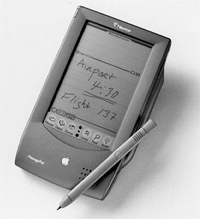
In 1989, Apple decided to build the Newton. The back story is actually much more complicated than this. Larry Tesler of Apple looked around the various processors that they might use and decided that the ARM had the best MIPS per watt, which was really important since battery life was critical (the Newton wouldn’t be any use at all if its battery only lasted an hour) but the computation needs to do handwriting recognition and other things were significant. But they also decided they couldn’t use it if the design team and compiler teams were all buried inside a minor division of Olivetti.

So ARM was spun out as a joint venture between Acorn/Olivetti, Apple and VLSI Technology. I had to fly from France, where I was by then living, to a mysterious meeting in Cambridge. I wasn’t even allowed to know what it was about until I got there. VLSI provided all the design tools that the nascent company needed in return for some equity, 5 or 10% I think, and also built the silicon. Remember, at this stage the idea was not to license the ARM widely, but rather to sit on the rocket-ship of the Newton as Apple created an explosively growing PDA industry. John Sculley, Apple’s CEO, was publicly saying the market for PDAs and content would reach $3 trillion. VLSI would sell ARM chips (this was just before a processor was small enough to be embedded) to other companies for other products and we would pay ARM a royalty plus pay them engineering fees to design the next generation. Or something like that, I forget the details.
Well, we all know how the Newton story played out.

Back then, microprocessors were not licensed except in extremely controlled ways. They would be second-sourced since large customers didn’t want to depend on a single semiconductor supplier in case their fab burned down or some other disaster interrupted supply. For instance, AMD originally entered the x86 business as a second source to Intel. VLSI was a second source to the Hitachi H8. The second source could also do its own business with the processor but it was never expected to be significant (hence all the lawsuits between Intel and AMD when AMD turned out to want to compete seriously against them).

Once it was clear the Newton was not going to be a success, VLSI continued trying to sell ARM and ARM-based designs to other customers. But nobody had heard of ARM and they were very reluctant to use what was then a largely untried microprocessor. There was too much technical risk.

Meanwhile, ARM had to work out how to make some money other than selling through VLSI. I have no idea if it was deliberate but just like IBM thought nothing of letting Microsoft license DOS to others (who would license it?) ARM had complete freedom to do this. Under Robin Saxby (now brave, brave Sir Robin) they licensed a dozen semiconductor vendors. Suddenly for VLSI Technology, nobody worried about technical risk any more, they had heard of ARM and wanted it. But VLSI also had a dozen competitors with almost the same product.

Also, around this time, cell-phones were transitioning from using 8-bit microprocessors for their control processors to delivering more compute power. They largely skipped 16 bit and so the ARM7 (or more accurately the ARM7TDMI) was designed into a good percentage of cell-phones. And luckily cell-phones did promptly take off like the Newton rocket was supposed to have done.

VLSI’s cell-phone business exploded too, with Ericsson representing almost 40% of VLSI’s total business at one point, almost all of it whatever was the current version GSM baseband chipset. Ironically, Ericsson, at that time, didn’t use ARM, they used their own implementation of the Z80.

When Compass was spun out from VLSI Technology, we inherited the ARM deal, namely providing everything ARM needed for free. Of course VLSI didn’t see fit to give us the ARM equity that was the payment for this, or Compass would have ended up being wildly profitable. It fell to me to renegotiate the terms with Tudor Brown (now President of ARM). It was difficult for both sides to arrive at some sort of agreement. ARM, not unreasonably, expected the price to continue to be $0 (which was what they had in their budget) and Compass wanted the deal to be on arms-length(!) commercial terms. It was an over-constrained problem and Compass never got anything like the money it should have done from such an important customer.

I eventually left Compass (I would return later as CEO) and ended up back in VLSI where one of my responsibilities was re-negotiating the VLSI contract with ARM for future microprocessors. It is surprising to realize that even by 1996 ARM was still not fully-accepted; I remember we had to pay money, along with other semiconductor licensees, to create an operating system club so that ARM in turn could use the funds pay Wind River, Green Hills and others to port their real-time operating systems to the ARM processor. Today they could probably charge for the privilege.

The business dynamics of ARM have certainly come a long way.

1

Classical fact of the day: this is the opening line of Virgil’s Aeneid (and also, in English, the title of a play by George Bernard Shaw.)

Posted in semiconductor | Comments Off

Finance

Finance is an area of business that is especially poorly understood by startup CEOs who tend to have engineering backgrounds, and underestimate the importance of everything else: account management, marketing and, of course, finance.

Let’s start with how EDA companies report their results. If you listen to conference calls or read press releases you’ll hear two sets of results. These are usually called GAAP (pronounced gap) and non-GAAP. GAAP stands for “generally accepted accounting principles” which actually doesn’t mean generally accepted but means as mandated by FASB (pronounced fazz-bee), the financial accounting standards board. This ought to be a bunch of experienced company financial executives, or perhaps a bunch of experienced investors. But it is actually seven academics on the east coast who’ve never run a company, or even been in one.

Accounting is fundamentally about cash, and if you run a small business then you probably use cash accounting since it is the simplest. But in a larger company it does a poor job of matching income and expense flows together. For that you use accrual accounting. The first change is that revenue and expense recognition are separated from the receipt or expenditure of cash. This matters a lot in a true manufacturing business: you ship a customer a widget and a bill and eventually they pay. Much better to record the money on the same day as the widget went out since it is payment for that widget, and it is just a minor detail that the customer didn’t pay for a few weeks. Similarly, you receive a widget and a bill and you record the expense that day, rather than worrying about whether you pay on 30 or 45 day terms. The second big change is that big-ticket items are not recorded as a single expense but are depreciated, recorded as a series of small expenses, over the life of the item (stepper, computer, fab). Again this does a good job of matching expenditure to use of the money. The stepper last for several years so it makes little sense to record a huge loss one quarter when you buy it, and unrealistically large profits for years while you use it. This is all pretty non-controversial although not so important for software businesses where a lot of money is not tied up in manufacturing plant, inventory, work in process and so on. But GAAP doesn’t stop there.

The trouble is that they have got so messed up with rules for depreciating goodwill, expensing stock options and so forth that they no longer really give a useful view of many companies’ financial situations.

Two examples: a big EDA company buys as startup for $100M and the startup has assets on its balance sheet of just $5M. There are some wrinkles concerned with in-process R&D and capitalized software development, but most of the remaining $95M is called goodwill. It is essentially a plug number representing the difference between the price paid and all the tangible things anyone can find to assign to part of the purchase price. FASB (and so GAAP) used to insist that goodwill be depreciated over a certain period like 20 years, but now insists that each year the company evaluates the goodwill it is carrying on its books to see if it reflects a true assessment of the value of the acquisition and forces adjusting entries if not. That is why, for example, Ebay wrote down billions of dollars due to acquiring Skype when it became clear they paid too much and so had a big paper loss one quarter, that everyone ignored. However, changes like this are somewhat arbitrary and generate fictional gains and losses, not to mention assets on the balance sheet that aren’t really assets (you can’t do anything with them like sell them).

Second example: stock options. When options are granted, which at the time of grant has no effect whatsoever on the companies financial position, FASB (and so GAAP) insist that an expense be recognized. But there is no real expense in terms of money changing hands. So of course this theoretical expense is wrong, and later corrections will be required to bring it in line with what actually happened. If the stock price went down, the options might expire unexercised so it is just as if they were never issued, and the original expense will need to be reversed. If the stock price goes up, they will be exercised and the company will actually gain a certain amount of money from the exercise, and the number of shares outstanding will change. But the notional value will need to be reversed since in the EPS (earnings per share) calculation, option exercise affects the “per share” part and not the “earnings” part, and pretending that it did messes up all the numbers.

Institutional investors ignore all this and focus on non-GAAP numbers, which take all that stuff back out again. In the case of a typical EDA company, non-GAAP numbers remove the depreciation of goodwill from startups acquired years ago, and also take out all the phantom value assigned to stock options. The non-GAAP numbers are much closer to what you need to assess how the business is doing. They are much closer to standard accrual accounting where cash payments are adjusted to do a better job of matching expenses and revenue to time.

For a really good summary of all that is wrong with FASB and GAAP I recommend T.J. Rogers, the CEO of Cypress Semiconductor, who wrote “Making financial statements mysterious”. It’s about 10 pages long. Here’s the opening paragraph:

I first noticed the misleading nature of Generally Accepted Accounting Principles a few years ago when an investor called to complain about the small amount of cash on our balance sheet. Since we had plenty of cash, I decided to quickly quote the correct figures from our latest financial report. But to my surprise, I could not tell how much cash we had either. With its usual—and almost always incorrect—claim of making financial reporting “more transparent,” the Financial Accounting Standards Board had made it difficult for a CEO to read his own financial report.

Of course I’m sure I’ve got some details wrong here. But that’s part of the point, finance is meant to summarize a business for executives and investors who are not deep finance experts.

Posted in finance | Comments Off