
ARM, Atom, PowerPC

What is a MID? It’s a Mobile Internet Device also known as a netbook. A huge battle is brewing as to whether a MID is more like a smartphone or more like a PC. It has major implications in the microprocessor market, the operating system market, for the smartphone manufacturers, for Apple and probably even the wireless network providers. Let’s look at the processors.

In the blue corner is Intel, obviously with a stronghold in the desktop and notebook PC market. They have AMD to contend with there but I’m afraid I don’t see how AMD can survive and I predict they will fall by the wayside. But that type of chip is too big and power-hungry, not to mention expensive, for other markets and so they have come out with Atom, which is a low-end embeddable x86 processor. However, it is still burdened with the x86 instruction set, which means that it requires a large and power-consuming instruction decode unit.

In the other blue corner is ARM, with a stronghold in the cell-phone market including the smart-phone market. All those 25,000 applications in the iPhone store run on ARM. Blackberries are ARM-based to, although just to add a wrinkle, manufactured by Intel (Intel acquired an ARM license when they acquired the semiconductor business of the old Digital Equipment Corporation, and renamed StrongARM to Xscale).

The battleground for the upcoming fight is the MID . These are notebook PCs with smaller screens and a much lower price point than a PC, but with larger screens than a smartphone. Intel with Atom is betting, along with Microsoft so far, that this market will demand windows binary compatibility and thus will require a Microsoft operating system and an x86 processor. ARM are betting that this is not true, that MIDs will hide the operating system, run new applications and so nobody will care what the underlying operating system will be. Which means that it will be some form of Linux such or perhaps Google’s Android (or if Apple enters this market as expected, OS-X which also Unix under the hood). Lurking around, of course, are the other smartphone operating systems, Symbian and Windows Mobile although they seem unlikely candidates for major success in the MID space (but primarily running on ARM in any case).

The really interesting wrinkle is whether Microsoft supports ARM with Windows 7 for this space. That would not give complete Windows binary compatibility but if Office was available (not just the operating system) that could be a very compelling compromise. Intel would be the big loser of this since Atom has poor power consumption and higher cost and really its only attraction is backwards compatibility with full-size PCs.

The big downside to Microsoft of supporting ARM, apart from the engineering cost, is the fallout it would likely provoke with Intel. But Microsoft has done this before when, while publicly committed to Itanium, they ported Windows to 64-bit x86 with AMD. By the way, this was done using Virtutech virtualization technology (before I worked there) with the result that Windows64 booted successfully the first day silicon was available, an extraordinary achievement.

One other wrinkle is the manufacturing. ARM is, of course, available from a huge range of suppliers. Intel will build Atom-based parts but is not in the ASIC business. TSMC will build Atom-based parts based on their recent announcement. However, the TSMC press release talks of expanding the “Intel Atom’s availability for Intel customers” which may just be marketing getting the word Intel in as many times as possible, or really may mean some serious restrictions on availability. Furthermore, the Atom is not a soft core and so can’t be prototyped in FPGAs. Whether this is a critical success factor remains to be seen. Based on my previous experience dealing with Intel, they won’t make any netlist available. Sometimes being paranoid to survive has its downside.

Lurking quietly in the 3rd corner of the microprocessor ring is PowerPC. This is heavily used in Avionics, automotive and networking (routers and cellular base-stations). It used to be the processor in the Mac, but Apple switched to Intel reportedly because they couldn’t persuade IBM to produce a low power PowerPC to keep Macbooks competitive. Both IBM and especially Freescale manufacture chips using it but somehow it is off the radar compared to ARM and Intel. One interesting facet is that Apple acquired PA Semiconductor who were developing a very low powered version of PowerPC. Apple are rumored to be producing chips embedding this processor so future Apple MIDs and possibly even future iPhones could end up with PowerPC, although it seems unlikely that Macs themselves will switch back due to the body of software that has just been expensively converted to Intel.

Ignoring the PowerPC (which at most may be a player with Apple) the bottom line is that Atom is more power-hungry and more costly (because it really is more expensive to manufacture) than ARM. Intel may be banking on getting a generation ahead in manufacturing process as a way to reduce both power and cost, but that won’t help anyone going through TSMC. ARM is much lower powered and so offers the prospect of a MID that has days of battery life (like the (ARM-based) Amazon Kindle has already, but with very different screen technology).

My gut feel is that a MID will be more like a souped up smartphone than a dumbed down PC, and so Atom will lose to ARM. In fact I think the smartphone and MID markets will converge. Microsoft will lose unless they port to ARM. There will be no overall operating system winner (like with smartphones). But a few minutes with Google will find you lots of people with an opposing view to mine.

Posted in semiconductor | Comments Off

EDP Monterey

The Electronic Design Process (EDP) conference takes place on April 9-10th in Monterey. Register by 31st if you don’t want to get dinged for the expensive rate. I’m giving the keynote at the dinner the night of 9th April so I hope to see you there. Gary Smith, the conference chair, accidentally described this as a “dimmer” speech in an email to me. I’m hoping to be more illuminating than that! Come along and find out for yourself.

The four main topics that you’ll hear about during the two days are:

  • Are threads dead? The quick answer is ‘yes’ but what we need instead will more nuanced. Multicore programming is the big challenge in electronics.
  • Challenges of RTL handoff. Lots of design intent is simply not in the RTL, and it is very difficult to pass tradeoffs (how much speed would you give up for how much power saving, for example). And how do you verify that the completed design was what you really wanted?
  • Will we miss the bus? On-chip buses are increasingly important items of IP that designers should not try to re-invent themselves. And are buses even the right answer to the question of how should communication take place between on-chip blocks?
  • Is the analog revolution really here? Digital design has become much more straightforward due to the broad range of powerful tools. Analog, not so much. Is that changing?

The website to find out more and to register is here.

Posted in admin | Comments Off

Designer plague

Unfortunately semiconductor is not the only thing that has some level of exponentiality going in its favor. For some areas this is a good thing: the human genome project spent 3 billion dollars to sequence the first genome (back when that was really money, before stimulus bills made a thousand million dollars seem like a rounding error). Now 23andme will do it for you for $399. Only a year ago it was $1000.

One area where this is worrying is terrorism. Back in 1945 it took the most powerful nation in the world using pretty much every single one of its physicists, and diverting a huge amount of its electric power, to develop an atomic bomb. For the next 30 years or so it took a really advanced nation to do so. Then even Pakistan and North Korea, nobody’s ideas of advanced nations, had atomic bombs. Soon, probably, Iran. But nuclear bombs are less worrying than biology.

But biology is getting easier and easier. It used to require national level biology labs and billions of dollars to develop any sort of pathogen that could be used as a biological weapon. But just as with the human genome project the scale required is coming down.

If you look at the potential for weapons to be really destructive, I think that there are two dimensions of especial interest: how big an organization (people, money, buildings) is required to create the weapon; and how localized is the effect of it when used.

If you create a really sharp sword, it may require a samurai master to make it but it doesn’t require a thousand of them coordinated. And the sharpest sword in the world cannot do that much damage, it is restricted to killing people around you.

A conventional bomb doesn’t require much to create, as we discovered in the first world-trade center bombing (and Oklahoma City bombing). Ammonium nitrate (fertilizer) and fuel oil will do the trick. It is moderately destructive on the building scale. But even with a shipload of explosives, you can’t destroy a whole city let alone a country.

Building a nuclear weapon or a designer plague virus today still is not something that an individual with the right knowledge can do in their kitchen. And building a nuclear weapon will never reach that stage, since it certainly requires complex machine tools, very high explosives and so forth. You are simply not going to set up a chain of gas centrifuges in your basement. But designing and manufacturing a pathogen looks like it will be something an individual can do in a non-specialist lab.

The hard part with biological weapons, if you want to have a fast effect, seems to be the delivery. It is hard to infect even a whole city all at once. But if you don’t care that it takes time, a contagious disease will affect most of a city gradually, just as smallpox and plague used to do, and gradually a whole country.

Today, if you are a lunatic bent on destroying the world, you can’t build a nuclear bomb on your own and you can’t yet design a contagious plague to kill us all off. But it is probably only a matter of 10 or 20 years before an individual can design his own plague.

Opposing that designer plague, biology can use national scale infrastructure to develop antigens or vaccines really fast. But defense is always difficult in this environment. If there are 100 pathogens, only one needs to get through, even 99% effectiveness at stopping them is not good enough. Look at the war between virus writers and virus detection software to keep our computers clean.

We are moving towards the era where anyone who feels sufficiently alienated can spend a weekend in his (it’s bound to be a him) garage and then maybe kill off the human race.

Posted in culture | Comments Off

Crushing fixed costs

There is a trend that the current downturn is only going to accelerate: to turn fixed costs into variable costs. Often this is what is behind outsourcing of some capability. Sometimes it is driven purely by either cost (let’s do it in China) or core-competence considerations (do we really need to run our own cafeteria?) but often it is driven by a desire to switch an inflexible fixed cost for a variable cost. Instead of owning a fab (fixed cost) then let’s just buy wafers from TSMC (variable cost).
There are two big problems with a large expensive fixed cost. One is just that it is expensive and so it ties up a lot of capital (or a lot of expense budget for a “fixed” cost like employees) for which there may well be more profitable uses. Second, the fixed cost usually puts in place a fixed capacity of some sort, and that capacity risks always being either more than the market need is, or less than the market need is.

TSMC makes money as a foundry, of course (well, maybe not right now). It’s scale is enormous so it may well be able to make money selling wafers for the same price as you can get wafers out of your own fab, even if you have one running at capacity. But that’s the point. Your fab is never running at capacity. It is either below capacity, in which case wafers cost more than the “standard price” because all that depreciation needs to be spread over fewer wafers. Or else it is above capacity, meaning that there are wafers that you could sell profitably that are not being built (if your planning is poor, you may even have orders for them, and commitment dates that you are going to miss). Even if you pay a price higher than your standard price for wafers, it is worth a lot to avoid having to absorb fab variances when the fab is not full, and to gain the capability to sell more than capacity when you have a strong order book.

In the web space, you no longer need to build your own high-capacity server farm. Amazon, Google and others will sell you server time and disk space on a purely variable cost basis. If you website becomes a big hit then scaling should be much more straightforward.

In some ways you can look at Amazon S3 or TSMC as companies that are in the business of making the up-front investment in fixed cost assets and then charging you a variable cost to use them. Lots of other companies do the same. It doesn’t cost an airline anything (well, not much) extra to fly an extra passenger; it is basically in the job of taking airplanes (fixed cost) and working out good business models to sell trips (variable cost). Cell-phone companies largely have a network of base-stations (fixed cost) and work out how to charge each customer for using them (variable cost). It’s not always obvious what the best model is for making the cost variable: do you charge data per megabyte, or unlimited data for a month? How does the money get split when you are roaming on other people’s networks? Is data the same price as the digitized data underlying a voice-call?

When supply chains disaggregate, usually one thing that happens is that non-core areas, especially ones involving fixed costs such as equipment or full-time employees, are divested. New companies spring up to specialize in providing that non-core activity as their core competence. Ross Perot made his fortune at EDS taking companies’ IT departments off their hands and created a big specialist company to provide those services. Semiconductor companies get rid of their EDA groups and an EDA industry comes into existence (Cadence, Synopsys, Mentor etc). Semiconductor companies get rid of some of their fabs and a foundry industry comes into existence (TSMC, UMC, Chartered etc). Semiconductor companies get rid of their technology development (TD) groups and rely on the foundry industry for that too. One interesting area of debate right now is whether design is next, and how much of design. Nokia already moved its chip development group into ST. eSilicon, according to Jack Harding its CEO, is doing very well. Faraday is (or at least was) doing about 200 designs a year.

When semiconductor companies design chips about as often as they reconfigure buildings, does it make any more sense to have their own not-very-expert employees floor-planning their chips than their own building architects floor-planning their offices.

Posted in finance, investment | Comments Off

Crossing the chasm

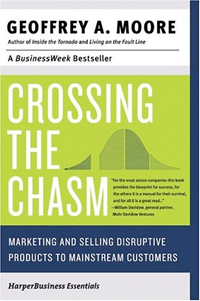
The most influential book on hi-tech marketing of the last twenty years or so has to be Geoffrey Moore’s Crossing the Chasm. I doubt that there is anyone in marketing reading this blog who has not read it. In fact everyone in hi-tech should read it since it affects not just how products are marketed, but how they are developed, where investment needs to be made and how, and generally what is required for a hi-tech product such as an EDA tool, software product, semiconductor chip or a system. If you are in engineering wondering why your product marketing manager is insisting that you stop work on the new whizzy feature for the next version in order to make sure that the current version reads some obsolete format of library then this book makes it clear why.

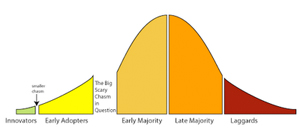
The key insight of the book is that the mainstream buys for different reasons than early adopters. As a result, it is much harder than you would expect to turn success with early adopters into success with the mainstream. Getting from this early success to the nirvana of mainstream adoption is crossing the chasm, the chasm being the fact that you can burn all of your money trying to get across unsuccessfully if you ignore what is necessary for success.

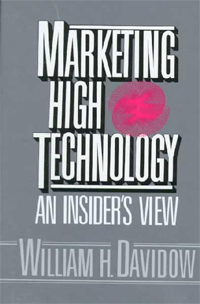
The big idea in Crossing the Chasm actually comes from an earlier book by Bill Davidow published way back in 1986 Marketing High-technology (still in print), which first introduced the idea of the “whole product.” However, Geoffrey Moore did a much better job of explaining it and the chasm metaphor was a much more viral image.

Early adopters will do their own work to make up for deficiencies in your product, especially tailoring it to work in their environments, adding missing scripts or libraries and generally working out how to get the most value out of your product. Mainstream customers will not do that. You need to deliver them everything that you need, the whole product. You may not need to deliver all this yourself, but you need to create an ecosystem so that everything is available.

A good example is the early days of Synopsys. You can sell a synthesis product like Design Compiler (DC) to a few early adopters on the basis that they will do their own work to take existing simulation cell libraries and manually create the .lib libraries necessary for synthesis. However, the mainstream will not. The mainstream wants the whole product, one that they can use from day one. This means not just DC but also .lib libraries for whichever library they happen to want to use for fabrication. So in the early days Synopsys had a huge group of engineers creating these libraries for the ASIC vendors. I think Bob Dahlberg, who ran the group, told me that it peaked at 200 people. Within a year the ASIC vendors realized that they needed to do this job themselves since they didn’t want Synopsys’s library group to be on their critical path to revenue from a new process node.

This shows another point, that once you start to achieve success in the mainstream, you become part of someone else’s whole product and they need to support you to be successful themselves.

The whole product becomes a barrier to entry too. Once Synopsys had all the ASIC vendors on-board, they were not likely to want to create libraries for other synthesis tools. So Mentor’s Autologic, Compass’s ASIC Synthesizer, Trimeter, SILC and all the other struggled not just because Synopsys could invest more in developing synthesis but also because nobody else could get the whole product together easily.

And here’s someone who gets it, although isn’t sure what to do about it. Chris Wilson, the CTO of NuSym, complains that there is now so much infrastructure required in a simulator (3 versions of the API, several testbench languages, Verilog, VHDL, SystemVerilog, C) that it takes all their effort just to do that and very little is used to deliver the core differentiated technology. Of course it would be convenient for him if someone else provided all that so that they can focus on their core technology, but nobody does. Synopsys didn’t want to develop ASIC libraries either. But he knows he won’t be successful without full compatibility.

Coincidentally, both Bill Davidow and Geoffrey Moore both ended up in the same venture capital firm, Mohr-Davidow Ventures (MDV). When we finally got MDV over the finishing line to invest in VaST while I was there, we ended up being invited to a half-day meeting with Geoffrey Moore. This lead to a dysfunctional conversation since I knew that the Mohr in the name of the company was spelled differently so I figured that somebody was confused about who we were meeting. But I was wrong: Geoffrey Moore was (and is) a partner of MDV. At that point VaST was having some early success in a handful of companies, mostly in Japan, and so we spent a very interesting afternoon brainstorming how we could create an ecosystem of models which we all knew was the main barrier to getting across the chasm.

Posted in book review | Comments Off

Guest blog: Paul Slaby

Paul Slaby is CEO of Kaben Wireless Silicon. He spoke at the annual D&R conference in Grenoble last December about whether or not the semiconductor industry will (should?) restructure itself along the lines of the pharmaceutical industry, with large distribution companies being fed by lots of smaller drug discovery companies. The big companies can’t take on the risky business He calls this the semi-fabless model. You can see a video of his talk here (it is about 20 minutes long).

Semi-fabless semiconductor

Starting with the early days, the semiconductor industry has evolved from “everything under one roof” to a variety of narrower or more segmented business models. That evolution took us from the IDM (Integrated Device Manufacturer) model to pure-play foundry, fabless, and IP provider (chipless) business models. From the entrepreneurial angle most of these models have significant problems and do not really address the realities of an early-stage semiconductor company today. Even those most recently developed approaches, such as the fabless and chipless models, have serious flaws.

The problem with the fabless model today, for any aspiring startup, is that with the unending growth in the complexity of semiconductor technology, its capital requirements have ballooned to stratospheric levels where a life cycle funding required typically exceeds $50M+ and more realistically upwards of $100M+, which is more than the appetite of most VCs. Not only that, but the complexity of technology, mix of highly specialized engineering and marketing skills required, depth and breadth of management needed, and just a common-sense chance that something likely will go wrong in such a complex business, makes the fabless model more and more risky and therefore less and less investment-worthy. Does it really make sense to embark on building such a complex machinery, where so many things could go wrong, and which costs so much, just because one has come up essentially with a single “better chip” idea?

The chipless, or IP provider’s model, on the other hand, has an advantage of a far lower capital requirement and much simpler operational infrastructure. Lower complexity makes it also less risky. As a result, it is being pursued by a large number of small, boutique-style, chipless semiconductor companies. It is possible to make a living being a IP provider but it is hard to make a killing. The biggest segments, such as microprocessors, are already mature. Remaining segments do not scale very well.

Despite the shortcomings of the existing semiconductor business models the industry is still dynamic and vibrant, thriving on innovation and creativity. How do we then proceed with capitalizing on this creativity while pursuing a viable business model that has a chance of success and a decent ROI for those involved?

I think that the time has come to further refine the way semiconductor industry is doing business and consider the break-up of the fabless model. In today’s economy, in many cases, the industry would benefit from splitting the fabless model into two parts: the development organization and the delivery organization. I call this the “semi-fabless model”. The semi-fabless company is essentially a combination of an IP provider, a design house, and an outsourced R&D operation. Its core competence and strength lies in specialized R&D and product development capabilities whereas it outsources product delivery operations to the “old” fabless company with the entire infrastructure and the pipeline to market already in place.

The semi-fabless (development) organization is paid largely by royalties from the fabless (delivery) organization. Trading off licensing fees, NRE and royalty payments gives some flexibility to the model. Typically the fabless company would private label the chips and market them under their own name.

On the financial side, the semi-fabless company avoids the need to raise huge amounts of capital and the risks of building a manufacturing operational infrastructure. And the fabless company avoids the development risks and costs while benefiting from expanding its product portfolio and having a pipeline of new products. Most importantly, the semi-fabless model is a scalable model due to the built-in royalties thus making it more investment worthy with manageable risk.  A big hit offers a big return but is much more capital-efficient.

Hat tip to Mark Gogolewski for pointing out this video to me.

Posted in guest blog | Comments Off

Lady Windemere’s FAM

In Lady Windemere’s Fan, Oscar Wilde wrote that a cynic is someone who knows the price of everything but the value of nothing. EDA companies are a bit like that. They only know the price of their tools.

How much money does Synopsys make on design compiler? Or Cadence sell of Virtuoso? The answer is that nobody really knows. Not even Synopsys and Cadence.

Of course the finance groups of EDA companies have their way of answering that question. They take the total number of licenses in a deal and add up all the list prices (for the appropriate time periods of course) and arrive at what is typically a very large number. They then take the actual value of the deal and from these two numbers (the deal size and the total value) arrive at a uniform access rate. Essentially they calculate a discount from list price assuming every tool received the same percentage reduction.

EDA companies didn’t really plan this effect. They bundled large portfolios of tools (Cadence called them FAMs for flexible access model) as a way to increase market share, and for a time it was very effective. By the late 1990s, for example, Cadence roughly took in $400M per quarter and dropped $100M to the bottom line. Having difficulty in doing the accounting afterwards was just an unintended consequence.

However, the reason that this doesn’t really work is that the list prices don’t reflect value to the customer. The customer and the sales team don’t really look at them. They think of the deal as delivering a certain design capability for a certain number of engineers, for a certain sum of money. Nobody wastes any time arguing that their Verilog simulation price is too high but they would be prepared to pay a bit more for synthesis, when the answer is going to be a wash in any case. That’s both the strength and the weakness of bundling, or what is often but misleadingly called “all you can eat.”

The biggest problem for EDA companies of this sort of accounting is that they lose price and market signals. Cadence didn’t realize that it was losing its Dracula franchise to Mentor’s Calibre until it was too late, since it never showed up in the numbers. Customers would simply refuse to pay so much for Dracula but the number of licenses in the deal wouldn’t actually get adjusted, so the allocation of the portion of the deal to Dracula hid what was going on.

During the heyday of Synopsys’s Design Compiler in the late 1990s, it was hard for them to know how much revenue to allocate to other products in the deal that might have been riding on its coattails. That’s without even considering the fact that Synopsys would want to spread the revenue out as much as possible to look less like a one-product company to both customers and investors.

This problem is not unique to EDA. I talked to a VP from Oracle that I happened to meet and he told me that they have the same issue. Without getting signals from the market it is very hard to know where they should invest engineering resources. EDA has it slightly easier here since the march of process nodes guides at least some of the investment toward areas that everyone knows are going to become important. Technology as well as price determines the roadmap.

EDA companies fly somewhat blind as a result of all of this. If in every deal Verilog simulation is priced too high, and synthesis is priced too low, then this has implications for how much investment should go into synthesis versus simulation. But if nobody bothers to adjust them in each deal so that the price discrepancy eventually finds its way into the aggregate numbers, then investment will be misallocated. This is good neither for the EDA company nor for the customer, since both benefit from investment being in the places that the customer cares most about, as evidenced by their willingness to pay more for it.

Oscar Wilde is most famous for the play "The Importance of Being Earnest" and also for being incarcerated in Reading gaol after being convicted of gross indecency with other men. Less well-known, he was married and had two children.

Posted in eda industry, marketing | Comments Off

It’s like football only with bondage

Woodrow Wilson once said “If I am to speak ten minutes, I need a week for preparation; if an hour, I am ready now.” Being succinct is really important when trying to close some sort of deal, whether it is a CEO trying to convince and investor or a salesperson trying to convince a customer. And as the Wilson quote shows, it is really hard.

Analogies are a great way of explaining things.  You probably heard that movies are often pitched in a ten-second bite “It’s like xxx only yyy.” For instance Alien: “It’s like Jaws, only in space.” Or Chicken Run: “It’s like The Great Escape only with clay chickens.”

Investors can be pitched this way too. They typically don’t really understand the technology they are investing in so it’s no good talking about how great your modifications to Kernighan-Lin are for next generation 32nm placement in a restricted design rule environment. Better to say “It’s like Silicon Perspective but taking modern process limitations into account.”

When I was at Ambit, we had a product called PKS (physically knowledgeable synthesis) which was the first synthesis tool that took physical layout into account in timing. But it was hard to explain to people why this was important back then, everyone was used to synthesis with wire-models and didn’t really understand the limitations. I found that the best way to explain it was that it was like trying to find the distance you’d have to travel to visit 4 cities in the US. It clearly makes a big difference if you know the cities are in LA, Miami and Seattle, as opposed to LA, Phoenix and Las Vegas. If you know nothing about where they are, which is the wireload model case, all you can do is use some sort of average and say it is 1500 miles. Always. This analogy also served to overcome the objection that we were not using the precise placement that would end up after physical design. If the cities are LA, Miami and Seattle, it doesn’t matter that much that the Seattle visit was actually to Portland; it’s close enough and a lot better than assuming Portland, Maine. I found that with this analogy people would immediately understand the reason for what we were doing and the limitations in the old approach.

Another analogy I like is in multi-core. Forget all the programming but just focus on the infrastructure. Everything assumes, or rather assumed, a certain model of programming: the programming languages, the hardware, the operating systems., the way programmers wrote code assuming that future computers would be more powerful not less It’s like containerization. The whole shipping infrastructure of the world is built on a standard sized container. Multi-core is as if someone suddenly said that you couldn’t have container trucks any more, for each big truck you used to have you now get a dozen FedEx delivery vans. In fact you can have millions of them, they are so cheap and getting cheaper. The trouble is that the infrastructure doesn’t work like that. The carrying capacity of millions of FedEx trucks might be much more than the container trucks, but the legacy stuff all comes in containers. It just doesn’t do to look only at the total carrying capacity.

A company I’m on the board of, Tuscany Design Automation, has a product for structured placement. In essence, the design expert gives some manual guidance. But people are worried at how difficult this is since they’ve never used a tool that made it easy. It really is hard in other tools where all you get is to edit a text file and don’t get any feedback on what you’ve done. The analogy I’ve come up with is that it is like computer typesetting before Macs and PageMaker and Word. You had text-based systems where you could put arcane instructions and make it work but it was really hard and best left to specialists. Once the whole desktop publishing environment came along it turned out that anyone (even great aunt Sylvia) could produce a newsletter or a brochure. It was no longer something that had to be left to typesetting black-belts. And so it is with structured placement. Once you make it easy, and give immediate feedback, and people can see what they are doing then anyone can do it.

Posted in investment, presentations | Comments Off

Semi equipment vs EDA

I had lunch with Lance Glasser a couple of weeks ago. He used to run about half of KLA-Tencor’s semiconductor equipment business (and I did some consulting for him back then). We got to discussing why EDA and semiconductor equipment are so different.

At first glance, there are a lot of parallels with EDA. Most notably the same customers, the same technology treadmill and a small number of large companies without a lot of differentiation in their product offerings. But there are big differences. For equipment, the innovation often comes in the big companies, which have shown themselves capable of both developing innovative technology (involving not just optics and hardware but also a huge amount of complex software—60% of the engineers at a typical equipment company are software and algorithms) and also getting that technology successfully into their channel. Big EDA companies are not good at that. Why the difference?

Semiconductor companies know that they need both new equipment for the fab and new design tools for their design groups in order to bring a new process node online. In general, the most advanced fabs (such as Intel or TSMC) work very closely with the equipment vendors on the spec of new equipment and then on ensuring that the equipment works properly in the new environment. If you think it is hard to get your hands on a netlist for a next generation design, try getting your hands on some test wafers when most of the equipment does not yet exist. And when the equipment is ready for production, the fabs have no expectation that they will get it for free in return for this work, though they will certainly drive for deep discounts. As Lance said, sometimes the customers think “JDP” stands for “jumbo discount program.”

One big difference is the way equipment is sold. Of course it is hardware not software, which means that neither the salesperson nor the buyer know the exact incremental cost and so what the profit margin is at any particular price, although Intel actually invests in a “should cost” program to work out what they think a piece of equipment should cost to give them better negotiating leverage.

Another big difference about hardware is that it has lead-time. If you want to open your fab by such-and-such date then the equipment needs to be ordered by a much earlier deadline. This makes the negotiation much more balanced: the equipment vendor can delay knowing that the clock is ticking. Yes, they want the order but the fab absolutely has to close a deal by a given day. The only time a similar situation would exist in EDA is if a big semiconductor company were stupid enough to leave negotiating a new deal until right up to the last day of the old deal when all its existing licenses would expire. Then the EDA company could just delay too. This advantage had decreased in recent years as the customers place a larger percentage of their orders within lead time (to try to transfer the inventory risk to the vendor), but it is still not a bad as with software.

The other difference about equipment is that it really is a one-time buy, a true “permanent license.” You buy a piece of equipment this year and you pay for it this year. Next process generation you don’t  “rebuy” all your existing equipment with just a soupcon of new stuff such as better optics. But with software you do. So even though a new piece of equipment may contain a lot of the previous generation in its design, the semiconductor company doesn’t expect to get that bit for free on the basis that they already paid for it in the previous generation.

The way EDA works, even the old days when EDA still had a hardware business model and sold permanent licenses, there was always a debate as to how much of a new product was incremental (thus expected to be included as part of maintenance) or was a new tool (thus required a new permanent license). Today, with time-based licenses, much of a salesperson’s quota may be “re-selling” the existing capability. When so much is riding on just keeping the customer on-board using the existing tools, the salesperson becomes very risk averse about selling new products. Unless the customer insists on buying, it is only a small amount of incremental revenue for possibly a large amount of incremental problems. From the salesperson’s perspective better not to include it in the deal at all. For the EDA company as a whole, in the short term and looking at just that one deal, this is rational. It is only in the longer term and in the aggregate that not getting new products into the channel is a slow death. Equipment companies often structure their sales incentives around penetration, share, and adoption of new products. More insidiously, this style of business (all your money for all your needs satisfied) means that EDA does not attempt to sell to value, does not attempt to increase the meaning of “all your money.” Customer companies, who know the value, make it hard discover for the EDA company. For example, it is hard to find out how heavily individual tools are used. Equipment for 45nm is harder to engineer than it was for 180nm and so everyone expects it might cost more. (It is not all one-sided, EDA companies don’t have to worry about wafer size changes—the equipment industry still hasn’t made back the cost of changing from 200 to 300 mm.)

An equipment salesperson is more like an EDA startup salesperson. If he or she doesn’t sell new equipment, there isn’t anything else to sell. Very little ramping of production goes on except in the latest processes. There is almost no market for new 90nm steppers today, for example (there’s probably a second-hand market though, they used to advertise that sort of thing on billboards along 101 between San Jose and San Francisco).

Little differences in the details seem to have a huge effect of the business. The fact that there is no concept of a software upgrade in equipment, the fact that hardware is solid and has real cost, that it has lead-time, has meant that equipment companies cannot go to zero on pricing, have to increase prices since their costs increase, and have to work closely with early adopters to mature the product. EDA companies have given up trying to sell the value of new products and so have given up trying to grow their customers budgets. So they don’t grow, and EDA is probably smaller than it was five years ago (if we exclude IP).

Posted in eda industry, marketing, sales, semiconductor | Comments Off

Standards

I was once at a standardization meeting many years ago when a friend of mine leaned over and said, “I tend to be against standards, they just perpetuate other people’s mistakes.” I think this is really a criticism of standardizing too early. You can only standardize something once you already know how to do it well.

In many businesses, the winner needs to be clear before the various stakeholders will move. Standards are one way for a critical mass of companies to agree on the winner. For example, Philips and Sony standardized the CD for audio and since it was the only game in town it was adopted immediately by vendors of CD players, the record labels knew which format to put discs out in, the people building factories to make the CDs knew what to make. A few years earlier there had been the first attempt to make videodiscs, but there were three or more competing formats. So everyone sat on their hands waiting for the winner to emerge, and in the meantime everything failed. When everyone tried again a few years later, the DVD standard was hammered out, it was the winner before it shipped a single disk, and the market took off. This was a lesson that seemed to have been lost in the HD-DVD vs BlueRay wars, although by then disks were starting to be irrelevant and downloading and streaming movies is clearly going to be the long-term winner.

EDA is an interesting business for standards. Since you can only standardize something you already know how to do, standards are useless for anything leading edge. By the time we know how to do something, the first batch of tools is out there using whatever interfaces or formats the initial authors came up with. Standardization, of the IEEE variety, lags far behind and serves to clean up the loose ends on things where there are already de facto standards. Also, EDA market expansion is not going to be driven by standards in the way that CDs were. Synopsys won synthesis (as opposed to Trimeter, Silc, Autologic and others) and so .lib and sdc became the standards, not the other way round. If all the other EDA companies had created a competing standard to .lib, nobody would have cared. It is the winningness not the standardization that is important.

Once the first tools are out there for some new technology, all using incompatible formats, then standard wars begin. The market leader wants its standard to become the de facto standard adopted by everyone. It is cheap for them since they don’t need to make changes; it is expensive for everyone else since they need to change their software to read the standard and probably make some internal changes so that their tool’s semantics match those implicit in the standard. Even if an IEEE-style standardization effort takes place, it is too slow. By the time the standard comes out it has often already been superseded by upgrading of the formats by the market leader to accommodate the realities of the process nodes that have come along in the meantime.

Customer behavior is very two-faced too. Every semiconductor vendor will talk about the importance of standards with a long solemn face. Especially their CAD managers. But, at least for their leading edge chips, they won’t put any money behind those statements and they will buy the best tool for the job whatever standards it does and does not support. Designing leading-edge chips is hard enough without worrying about whether some abstract standard is open enough.

Of course, once a market matures then supporting the de facto standard is an important part of “best tool for the job”. When I first started in EDA, Calma still maintained that GDSII was a proprietary standard that nobody else was allowed to read. However, every Calma system shipped with a file describing the format, so I took the legally dubious step of reading that file, and a couple of days later we could read chips into the VLSI Technology layout editor. A layout editor that didn’t read GDSII wasn’t really a layout editor no matter how good it was at editing layout.

So expect customers and EDA vendors going forward to talk a lot about how important standards are. But expect them to produce and buy the best tool for the job and the standard to emerge from the competition for that honor.

Posted in marketing | Comments Off