 Today’s guest is John Lambert. He is another Brit and is currently CEO of Virtutech (I was his VP marketing for a time). Prior to that he still has the scars from many years at Rational starting from the early days up until IBM acquired them, originally back in the UK and then over here. His blog was due to go out earlier but he has the modern equivalent of “the dog ate my homework."
His entry echoes some of the things that came up at last week’s DVcon panel, that IC design is only a part of the design problem.
Near death experiences
When, a few weeks ago, Paul asked me to write a blog entry, essentially to cover his rear end whilst he was gallivanting about in Mexico, I duly sat down and began to pen something suitably earnest on the future direction of EDA. Then, while twiddling my thumbs and staring out of the window hoping for some lightning bolt of inspiration to strike, I read a few of the earlier posts in order to get some more context. Fast concluding that in fact I had little new to say in that regard, I thought I’d do something different and instead focus more on the bigger picture. I’d construct a grand, sweeping, vision of how product development would look in the 22nd century and what collectively we’d all need to do in order to get there.
It was all going swimmingly well until one Thursday night when my laptop tried to commit suicide by downloading a poisonous .Net update all by itself. Not sure why. Perhaps the whole futility of it all triggered some innate nihilistic tendencies buried deep within Windows Vista – because Lord knows they are in there somewhere, as any regular user of that abomination will readily testify – but whatever the reason, the net result (pun intended) was that by the time the PC was suitably detoxified I’d lost the thread of the epic story I was going to tell. Here instead, therefore, are a few basic points that I will make in the form of blank statements without bothering to justify any of my thinking. It’s just easier that way.
 Follow the money. OEMs are in the business of building and selling things. Those things include chips and software, but that’s entirely incidental to the business they are actually in. The things they sell are either few in number and very expensive, or manifold and cheap, but either way those guys are the ones coining it, not the purveyors of the necessary picks and shovels. No use whining about it, that’s just the way life goes.
- Complexity kills. Making stuff is hard, and getting harder. Everybody wants the things they buy to do more, be cheaper to buy, breakdown less and to be available sooner. Year-by-year, this makes the whole shooting match harder to manage regardless of volume, price or scale.
- It’s good to talk. Building stuff has become multidisciplinary. Alas, we got here through rigid specialization. Stovepipes are good at keeping stuff contained, managed and concentrated (smoke, most typically) whereas what’s now most important are things like collaboration, iteration and exchange. This is a fundamental industry shift that is still only in its infancy. It’s important, OK?
- Don’t sweat the small stuff. Why spend another $5m on upgrading your ASIC design tools when the end product, an ASIC presumably, accounts for only 20% of the hardware, the design and development of which consumes just 10% of the overall project budget? It makes no sense. Ditto buying a better compiler or smarter test tool. “Commoditization is murder”. Now there’s a slogan to live by. Or do I mean die by?
- Complacency is death. So why on earth are all the EDA companies seemingly so stuck in their own stovepipe, refusing to strike out and fully embrace the broader product lifecycle? At least, that’s what you’d conclude from a number of the posts here, and indeed from looking at how intent they seem to have been over the past few years on getting better and better at serving the needs of a market slice that’s been getting smaller and smaller. Just how bad does the economic outlook for the industry have to be before one of the herd strikes out on their own to find greener grass way over yonder?
Someone, somewhere, soon will figure out that there’s room for one company to do for product America what the likes of IBM, HP and others have done for enterprise America, namely, to become the one partner that can pull together the deeply divided worlds of EDA, PLM and software, forging in the process a vendor with the breadth to truly breakdown those silos, thereby paving the way for the creation of new and innovative development processes. This HAL Corporation will supply both tools and techniques – process as well as product – that allow customers to systematically and repeatably shorten the overall end-to-end cost of designing, developing and delivering a new product. As a result, hundreds of man years of effort will be shaved from the total development bill, delivering results in timescales dramatically shorter than anything possible today.
All of this will happen because it has to happen. Market forces demand it, complexity dictates it. It just requires someone with the cojones to strike out, to make the first and boldest of moves.
Anyone want to lay bets on the most likely candidate to lead that charge?
Bottom-line: it’s time to welcome in the revolution; further polishing of the current stovepipes only results in shiner stoves, not warmer houses. I rest my case.
 For some time I have been talking about the semiconductor industry as the Fab 5, since there have been five process “clubs”. A few players hedge their bets and are in more than one club. The fab five are Intel (a club on its own), UMC (along with Xilinx and Texas Instruments), IBM (along with Samsung, ST, Infineon, AMD, Sony, Freescale and Chartered), Japan Inc (Renasas, Toshiba, Fujitsu, OKI, Sharp, Sanyo, Matsushita) and the big one TSMC (with AMD, TI, NXP, ST, LSI, Sony, Qualcomm). Japan Inc in particular is messy with Toshiba tied closely to NEC (in the TSMC club) but to Sony (in the IBM club too), Renasas and Fujitsu are still sort of going it alone. Japanese politics would indicate that they will all get together somehow.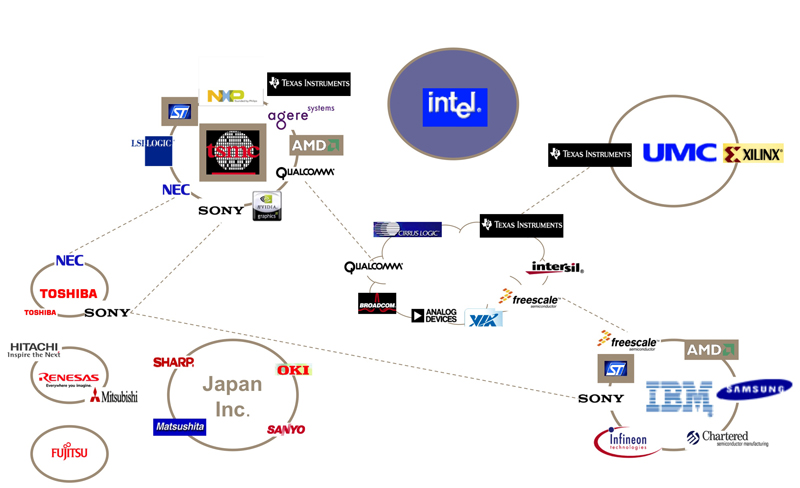
 In most businesses, every company doesn’t feel the need to make every product that it sells. When you buy a car from General Motors, they don’t make the ABS system themselves, they buy it from Delphi or from Bosch. When DEC came out with the Vax, they didn’t feel the need to make their own graphics terminals, they bought them from Tektronix and re-badged them.
 I went along to what used to be John Cooley’s EDA bigwigs panel and is now Peggy Aycinena’s “Is EDA dead or alive?” I had to keep asking myself am I dead or alive for the first part of the panel as each panelist insisted that their company was not suffering at all in the current downturn, there were no layoffs, and every EDA engineer gets a pony for their daughter. I may have misheard that last bit.
 oday’s guest blog is from Grant Martin, Chief scientist at Tensilica. He worked for Burroughs in Scotland (in Cumbernauld, of all places, which makes Newark look attractive), Nortel in Canada, and then at Cadence before moving to Tensilica. He literally wrote the book on system design, most recently co-author of “ESL and System Design”. The British press used to have a rule that they would never mention another newspaper by name, but just say something like “in another newspaper.” Well, Grant has his own blog in
 The mystery of whether Blaze DFM had closed down or not is over. It has been
  In the 1980s, chip design was focused on layout: cramming all those gates into as few chips as possible, trying make use of every square millimeter of silicon. The 1990s were the decade of timing, when all the tools became timing driven with a completely synchronous design methodology. Of course area was still important but the biggest headache for designers was closing timing. The 2000s seem to be the decade of power, where the biggest headache is now meeting the power budget.
 I’ve given lots of keynote speeches about EDA over the years. You too can give your own keynote if you follow these simple secret guidelines.
 I already took a cursory look at the fact that the